
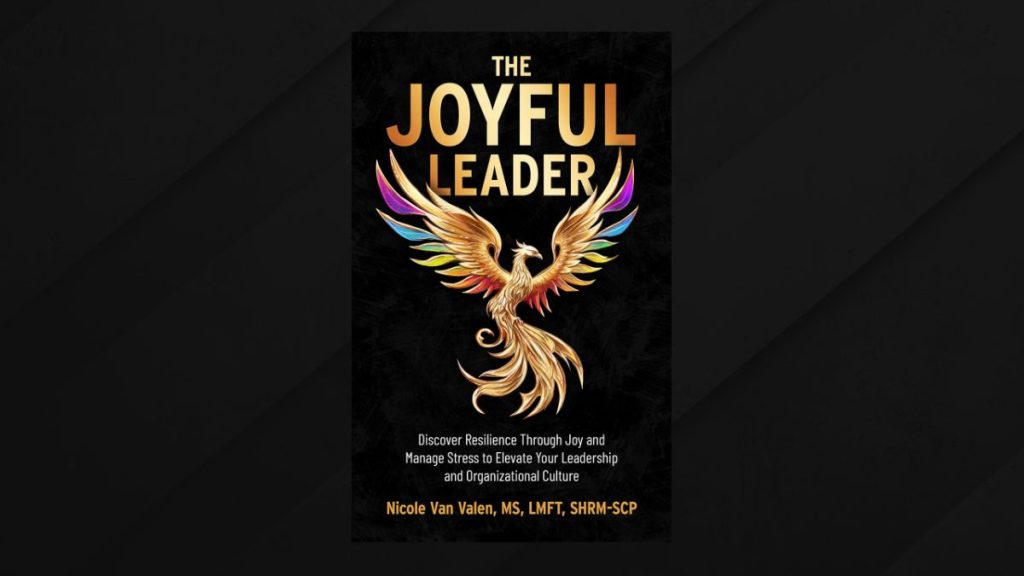
Why the Phoenix?
The phoenix is not a symbol of survival.
It is a symbol of elevation.
The phoenix rises from its own ashes, not unchanged but in an expanded state. The fire does not end the story. It refines it.
That is ignited leadership.
Every leader faces pressure:
- Burnout
- Public scrutiny
- Organizational instability
- Silent self-doubt
The question is never whether you will encounter fire.
The question is how you will rise from it.
The Cover of The Joyful Leader®: You in Motion
The phoenix on the cover is intentionally directional. It may appear abstract or decorative, yet it represents the full emotional journey that shapes resilience.
However, when readers see the phoenix, they are meant to see themselves.
You in the middle of growth.
You in the middle of rebuilding.
You rediscovering clarity after exhaustion.
The wings are fully extended because this requires expansion under the fire. And no, it’s not as easy as it appears.
The Colors of the Wings: The Spectrum of Leadership Capacity
The wings are layered in color for a reason.
In The Joyful Leader®, the phoenix is always gold, symbolizing the innate value and essence each of us carries within. That golden core does not disappear in adversity. It remains constant.
The colors in the wings reflect lived experience.
Color influences emotional response and behavior. In leadership environments, emotional climate influences and drives cognitive output. The phoenix shows that resilience is built by moving through emotion, not bypassing it.
Each color represents a stage of emotional experience and transformation:
Red: Rage and intense emotion: the signals of the beginning of significant challenges.
Orange: Anger harnessed with awareness: the emotion that becomes fuel for change and growth.
Yellow: Both unhappiness and the warmth of happiness: the embracement of the present as a stepping stone toward a brighter future.
Green: Renewal and steady nurturing: the sustainment of the joy required to thrive even amid trials.
Blue: Bliss: the deep contentment that comes from overcoming obstacles and aligning with purpose.
Purple: Transcendence and profound insight: the wisdom gained through experience.
Black (background): Love: the supportive force that allows resilience to rise with compassion and understanding.
Gold: Inherent potential and purity: your unchanging essence.
Resilience is not about suppressing red to reach blue. It is integrating every color. When leaders ignore emotion, environments turn gray — reactive, rigid, constrained. When leaders acknowledge and integrate experience, color returns, and with it clarity, growth, and wisdom.
This is why emotional climate determines intellectual output. The phoenix does not rise in gray. It rises in color, rooted in gold.tional climate determines intellectual output. The phoenix does not rise in gray. It rises in color, rooted in gold.
Psychological Safety: The Hidden Wing
Research from Harvard Business School’s Amy Edmondson shows that psychological safety is foundational for team learning and performance.
Source: https://hbr.org/2018/01/the-fearless-organization
Without safety:
- Leaders calculate risk instead of contributing ideas.
- Teams withhold dissent.
- Innovation slows.
With safety:
- Curiosity expands.
- Debate strengthens decisions.
- Energy stabilizes.
The phoenix’s green wing reflects renewal and the steady nurturing of sustaining joy, the capacity to thrive even amid trials. Resilience without safety becomes endurance. Resilience with safety creates the conditions for renewal and sustaining joy.ience without safety becomes endurance. Resilience with safety creates the conditions for renewal and sustaining joy.
Strength and Softness Are Not Opposites
One of the core tensions leaders feel today is this:
How do I stay strong without hardening?
Burnout data continues to rise:
- 51% of managers report burnout (Gallup).
https://www.gallup.com/workplace/353081/state-of-the-global-workplace-report-2022.aspx - 75% of employees report moderate to high stress.
https://www.stress.org/workplace-stress
But data does not show the emotional whiplash of leading while depleted.
The phoenix represents integration:
- Strength and softness
- Accountability and empathy
- Strategy and humanity
What could be seen as weakness is actually expanded capacity.
March: A Season of Emergence
TThis blog begins our March series, centered on spring and renewal.
Here’s what’s ahead:
- March 8: Rocky Balboa: Resilience Under Pressure
- March 15: Joy and Luck: Agency vs. Randomness
- March 22: Spring into Joy: Renewal as Strategy
- March 29: Spiritual Resilience: Leadership During Holy Week
Each builds from this foundation: Transformation begins with identity.
And identity shapes emotional climate.
Why This Matters for Leaders Now
Organizations are not failing because leaders lack intelligence.
They are struggling because emotional environments are depleted.
The phoenix on the cover reminds leaders:
You are allowed to rise differently.
You are allowed to lead with expansion.
You are allowed to restore color to your culture.
Yes, optimism is important. But spring is about renewal.
FAQ
What does the phoenix symbolize in leadership?
It symbolizes renewal through adversity; the ability to rise stronger after challenge rather than simply endure pressure.
Why use the phoenix on a leadership book cover?
It visually communicates transformation, resilience, and expanded capacity, reinforcing that leadership growth often emerges from difficulty.
How does psychological safety relate to resilience?
Psychological safety stabilizes emotional climate, enabling leaders and teams to take intellectual risks and innovate without fear.
What do the colors of the phoenix wings represent?
Summary
The phoenix symbolizes renewal in leadership. On the cover of The Joyful Leader®, it represents the reader’s capacity to rise stronger after adversity. Through color theory, psychological safety research, and burnout data, this article introduces March’s leadership theme: springing into renewal with expanded capacity.
Strategic Call to Action
If this message resonates:
Explore The Joyful Leader® → nicolevanvalen.com/book.
Bring Joy Powered Performance™ to your organization.
Assess your leadership climate with the Sphere of Resilience® Assessment.
The phoenix is not a fantasy.
It is a decision.