
Nobody assigned me anyone. Nobody scheduled a session. I watched how several of the entrepreneurs in the room ran their businesses, how they folded their own passion into the way they treated their clients, and I took mental notes I didn’t know I was taking. I sat in conversations that quietly reorganized something in me. I saw my own value reflected through somebody else’s eyes, which is a thing we cannot do for ourselves no matter how much self-awareness we’ve built.
They were modeling the way. Most of them have no idea they were doing it.
The Circle Closed Fast
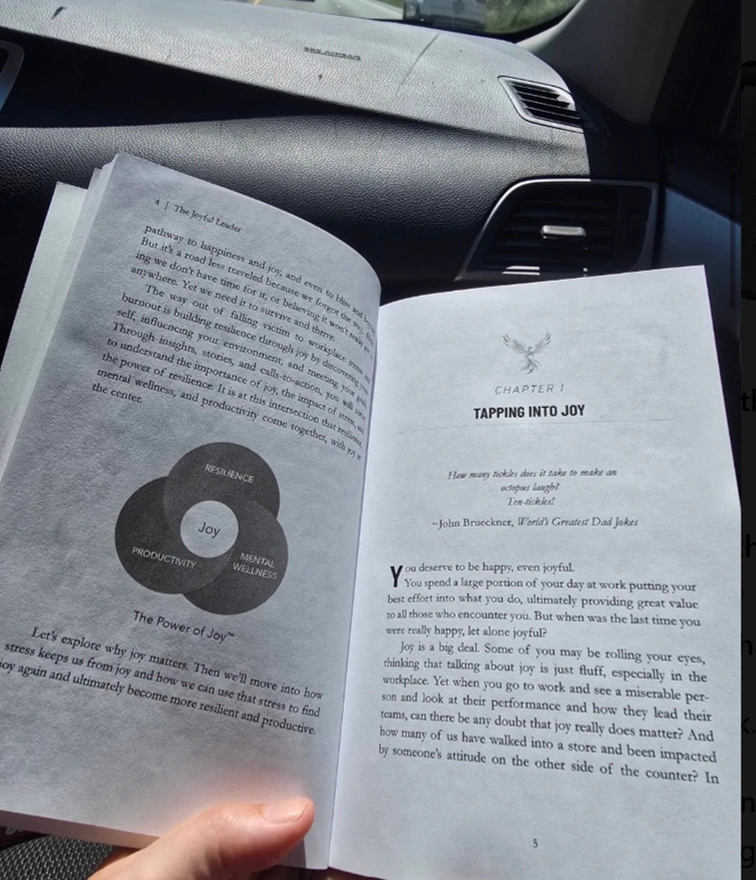
On the last day, one of the participants brought her copy of The Joyful Leader® over for me to sign. She started reading it on her drive home and sent me a photo of the book open in her lap, showing the Power of Joy diagram and Chapter 1, Tapping Into Joy. “Officially starting your book!” she said. “I’m going to recommend your book to my superintendent for teachers to read during Institute Day this next school year.”
That same retreat week in the same room, I was being mentored and mentoring at the same table, and I hadn’t planned either one.
Taft Parsons III describes mentorship, sponsorship, and relationship-building as a circular system, and I think that’s exactly right. We keep drawing it as a ladder with someone above reaching down when it actually moves in a loop. You get mentored through a conversation on Saturday and mentor someone through a book on Sunday.
Most of Us Are Waiting for Permission
Here’s what I notice in almost every leader I work with: They’re waiting to be assigned a mentor. They’re waiting for a program, an invitation, or a moment when asking wouldn’t feel like an imposition.
That moment doesn’t arrive. And while we wait, we drift into somebody else’s plan for us.
Years ago, one of my mentors said something that rearranged my whole career: “Nicole, you need to think through your career path. You are so diverse in your abilities. You can do anything that is asked, and you get pulled into so many things.” That last part was the diagnosis for my burnout, though neither of us called it that. Then she said, “You need to think through your career path. What space do you want to be in?”
I’d been saying yes to everyone else’s path. It had never occurred to me that designing my own was my job and nobody else’s.
If we don’t design our lives, someone else will. Mentors are often the ones who point that out before we’ve lost another five years to it.
Your Mentors Are Already in the Room
A mentor doesn’t need to know they’re your mentor. Many times, someone has mentored me from a distance through their posts, their thought leadership, their example. When I finally meet them, I tell them so.
Finding mentors can be this ordinary:
- Reading memoirs of people you admire
- Following thought leaders on social media
- Listening to guests on podcasts
- Watching documentaries
- Asking for advice as needed
- Setting up quarterly meetings
Our mentors can come from different time periods through books, different locations through virtual meetings, and different industries through conferences. The sky really is the limit, and none of it requires anyone’s permission.
Adam Grant’s research on givers and takers found something that should make this easier: Givers look for opportunities to contribute to others through advice, introductions, mentoring, and sharing knowledge without expecting something in return. For them, helping isn’t simply something they do when they have spare time. It’s part of how they interact with others.
Build a Board, Not a Bond
One mentor can offer only one perspective. That’s why I’ve learned to build a board of mentors rather than depend on one person for every kind of guidance. When that relationship ends, moves, or gets busy, all your guidance goes with it.
My mom is part of my board of mentors. So is a speaking coach I found through volunteering. So are a handful of people who have no idea they’re on it. Different vantage points, different blind spots covered. It’s nice having a mentor because they can see what we can’t, especially when we’re so far inside a problem that we can’t see it clearly. One person can see only so much.
This is also where mentorship strengthens our resilience directly. Social resilience and professional resilience are two of the areas measured in What’s Your Sphere of Resilience®, and both of them depend on the quality and the range of the people in our corner. A board widens that range.
The Paragraph That Starts It
If there’s one thing to do this week, it’s this: Write a short paragraph to someone you’d like to have as a mentor, using three moves:
- Show gratitude. Thank them for the advice they’ve already given you.
- Ask for what you want. Find out whether they’re willing and able.
- Share expectations. Reinforce the relationship you already have and name what you need next.
Here’s the version I use:
“I really appreciate the great advice you’ve given me thus far in my career, and I think you could be extraordinarily helpful as I navigate these next couple of years. Would you be willing and available to help me as needed and act as a mentor? I believe you know me very well, understand conceptually what I’m trying to accomplish, and will speak frankly, confidentially, and honestly with me.”
If a full mentorship request feels like too much, ask for 15 minutes instead. That’s the entire premise of the 15-Minute Calendar Strategy®. Fifteen minutes is short enough that people say yes and long enough to change the direction of a career.
Both Sides Carry It
Nicole Hunt, a social worker I mentored, put her finger on what makes these relationships hold: Trust gets built through consistent support and responsiveness, from both people. The mentee sets the agenda. The mentor stays reachable and genuinely invested. Neither one is passive.
Which brings me to the part we skip. For every 15 minutes I’ve received, I try to give 15 to someone else. Not as an obligation but because mentorship goes full circle, and the whole thing only works if it keeps moving.
Most of us, if we’re lucky, have had someone who reached out a hand and lifted us up. Let’s be that for someone else. Let’s be the ones who reach out, who mentor, who stop what we’re doing to link arms with someone else even when there’s seemingly nothing in it for us.
Ready to map who’s already in your corner and where the gaps are? The Joyful Leader® Toolkit includes the What’s Your Sphere of Resilience® assessment and the reflection prompts I use to help leaders design their board of mentors.