
You lead from where you are by choosing how you respond before your circumstances change. Leading from where you are means taking initiative, building relationships, and demonstrating judgment in your current role, and that choice is what causes doors to open rather than something you do after they’ve already opened.
A Two-Second Decision
I was watching Ted Lasso not long ago, and I was left thinking, here’s a man who coached at the highest level of professional sport, now doing an ordinary job, wearing the same warm, uplifting smile he wore on the sideline. He wasn’t pretending. You could see the sadness move across his face when he passed children playing soccer on his drive home. He did really miss it.
And then, in less than a second, he chose joy.
That’s leadership. It’s not about the title, the office, or the moment when what you want finally arrives. Leadership is what we choose in the two seconds after the disappointment, and other people are always watching those two seconds.
Being joyful is a choice. Some weeks it’s a hard one, especially when our environment feels harsh and nothing about our conditions is asking us to be joyful. Joy isn’t the reward we get once things improve. Joy is the resource we bring while improving.
Why Joy, Again
We’ve spent a lot of weeks together in the practical work: strengths, weaknesses, the design of a landscape, the shape of a network. So let’s say the quiet part out loud again before we go further.
Joy goes beyond being just a mood. Joy is a performance resource. When we’re operating from joy, we make clearer decisions, we recover faster, we’re more generous with the room, and we’re far more likely to be the person others want beside them under pressure. Every framework I teach sits on top of that one claim: Leaders who protect their joy outperform leaders who postpone it.
That’s why this work is vital. And this is the week we put it to use.
What Professional Resilience Actually Is
Professional resilience is the piece that makes leading from where you are possible.
In The Joyful Leader®, I define it this way: Professional resilience involves harnessing environmental resources and support systems to navigate and thrive in vocational settings. This type of resilience enables us to adapt to challenges and changes in our careers successfully, and it helps us enjoy our work and maintain positive interactions with colleagues and others in the professional environment.
Read that again and notice what it doesn’t say. Professional resilience isn’t grit. Professional resilience isn’t enduring more than everyone else. Professional resilience is a resource-gathering skill. It’s the ability to look at the environment we’re actually in, harsh or not, and find what’s usable in it: the colleague who returns calls, the mentor who tells us the truth, the association membership we’ve been paying for and not using.
Nadya Maree, a professional counselor with more than fifteen years of experience, said something in our interview that I return to constantly: “The practice of developing support networks has allowed me to seek out opportunities that have been shared with me by others, opportunities that I might not have sought out for myself.”
That’s professional resilience in one sentence. Our networks see possibilities for us that we can’t see for ourselves.
What You’ve Already Built
You’ve done more preparation than you’re giving yourself credit for.
You’ve identified your strengths and named the areas where you’re still growing. You’ve located where your true joy actually lives, which is harder work than it sounds, because most of us have been performing a version of it for years. You’ve mapped your Sphere of Influence and figured out who’s genuinely in your corner. Y-0ou’ve discovered what landscape you’re in and how to not just accept the one you inherited
All of that was the Ready stage. Ready is where we discover. Set is where we design, and Set is where we are now.
When you’re Set, you can approach situations with clarity, purpose, and a sense of control, which significantly reduces the stress you experience and enhances your ability to not only bounce back from adversity but propel forward in designing your future.
Who Are You as a Leader?
Sit with that question for a moment before you answer it.
In the Ready stage, that question was about discovery: What kind of leader might I be? In the Set stage, the question sharpens: Who am I as a leader, right now, with everything I’ve just gathered? Understanding and embracing our unique qualities as leaders is what sets us apart, and it means identifying our core values, our strengths, and the attributes that make us uniquely suited to lead.
Here’s the part worth naming honestly. Research published in the Journal of Business Ethics explores how self-deception can create barriers to leaders’ self-awareness, making it harder to recognize and accommodate their own weaknesses and potentially limiting their ability to build trust and lead authentically. The answer to “Who am I as a leader?” can’t come only from inside our own heads. It must also come from reflecting on our past experiences, seeking feedback from those we trust, and aligning our leadership style with our personal values.
Write your answer down this week in one paragraph, in present tense, not future tense.
Leading Before the Title
To demonstrate that you’re ready for a leadership position, it’s crucial to begin by leading from your current role. Start leading from where you are, and somehow doors begin to open.
That mindset shifts our focus from waiting for opportunities to actively creating them. Four practices make it visible:
- Build financial and business acumen. Go beyond understanding the numbers and learn to read the story behind them. That’s what makes your judgment trustworthy to the people deciding who gets more responsibility.
- Strengthen project and initiative management. Take ownership of something from start to finish. Track it, communicate through it, adjust it. A track record is built one completed thing at a time.
- Build organizational savvy. Learn how work actually gets done where you are, who the real stakeholders are, and whose expertise fills the gaps in your own.
- Increase your autonomy in decision-making. Seek the situations where you can decide, weigh the short term against the long term, and be willing to adapt when the outcome surprises you.
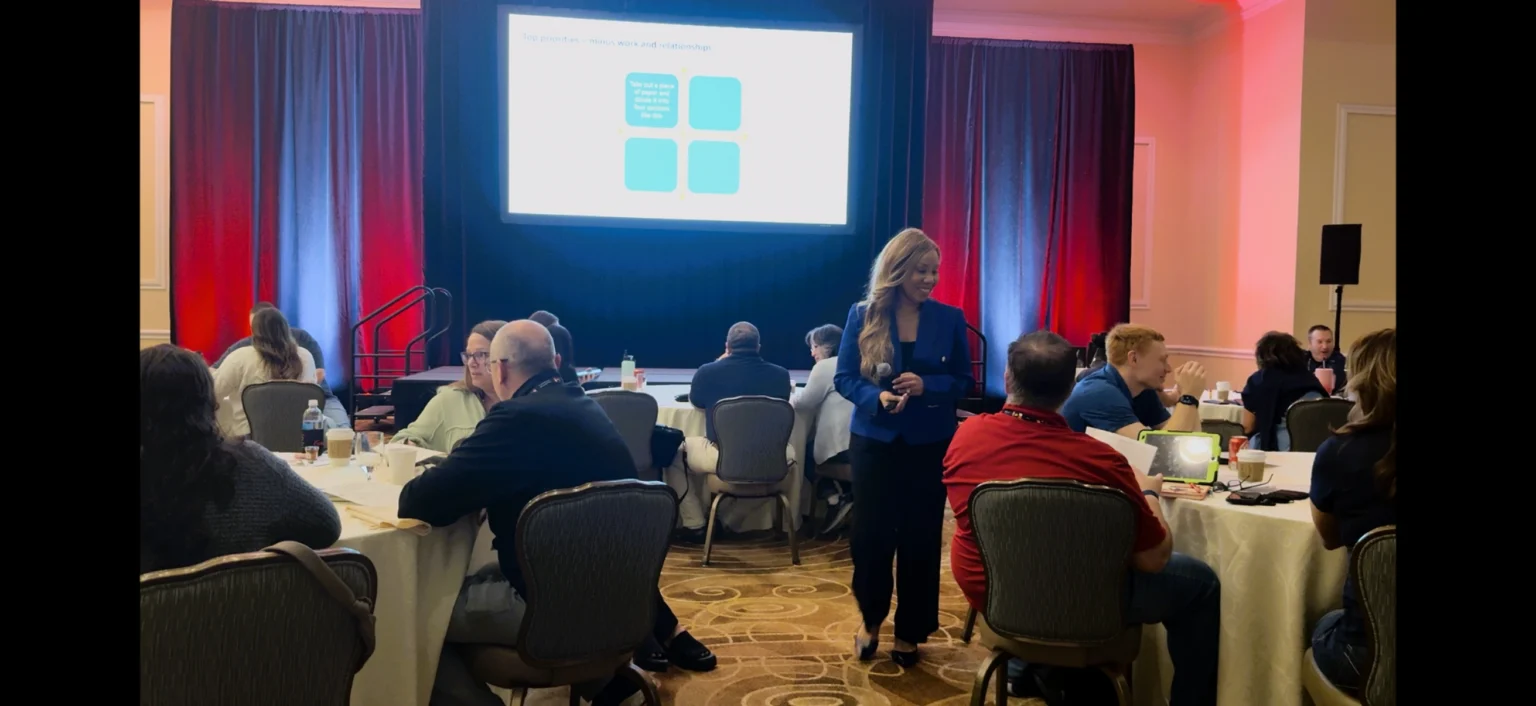
I watched this happen in real time at a conference breakout session. A peer sitting next to me whispered a question she wanted to ask the panel. I told her to ask it out loud and she did. That question was so thought-provoking that it revealed her expertise to the entire room, and she was invited to sit on the next conference panel.
She didn’t get a promotion first. She led from her seat.
Conference Networking, Specifically
We’ve talked about designing our networks. Now let’s get specific about the how, because strategic alliances rarely form by accident.
Conference networking fast-tracks learning and connection inside an industry, and it works whether it’s your industry or one you want to understand better. I attend healthcare conferences, HR conferences, and meeting planner conferences. As a lifelong learner, I’ve come to value connection more each year, and I mean true, authentic connection rather than a stack of collected cards.
Attending conferences is a wonderful way to stay current on market trends, learn about innovation in your industry, and have conversations with like-minded peers. Expanding your sphere of influence at a conference goes well beyond attending the breakout sessions. The magic is in the insights gained, the relationships ignited, and the future partnerships built.
Here’s how to work a conference:
Before. Update your materials and digital presence. Research who’s attending and how they align with your goals. Set measurable objectives by finishing this sentence: “By the end of this conference, my three takeaways are…” Prepare an elevator pitch you can deliver without apologizing for taking up space.
During. Talk to the person seated next to you. My openers are ordinary on purpose: How are you enjoying the conference? Which session has been the most impactful? What did you think of the last speaker? Then: I have a follow-up question for you, if you don’t mind. May I have your contact information? Here’s mine.
After. Follow up within forty-eight hours. Sometimes I stay an extra day at the hotel just to do it properly. Give something in the follow-up rather than only asking. Two takeaways from the conference is plenty.
Adam Grant’s research on prosocial motivation helps explain why this approach matters. Relationships tend to strengthen when we contribute value through help, knowledge, encouragement, or connection without treating every interaction as a transaction. That is why I recommend building relationships with capable, generous people before you need support, not as a networking tactic but as a practice of mutual contribution and trust.
For Labor Day
This week we honor labor, and I want to honor yours.
You’re doing the work: the reflection, the feedback conversations, the follow-up emails nobody sees, the two-second decisions on hard days. That’s real labor, and it compounds. As we move through this week and toward Patriot Day, I hope you’ll give yourself credit for the quiet, unglamorous building you’ve been doing.
You don’t need permission to lead. You need a decision, and you already know how fast one of those can be made.
Keep choosing joy!
Call to Action
Ready to design the leader you’re becoming? The Joyful Leader® Toolkit gives you the reflection prompts and practices behind the Ready, Set, Go® framework: https://nicolevanvalen.com/the-joyful-leader-toolkit/
If your team or association is ready to do this work together, let’s explore it together: nicolevanvalen.com/speaker